The PPI and Coffee Conflict
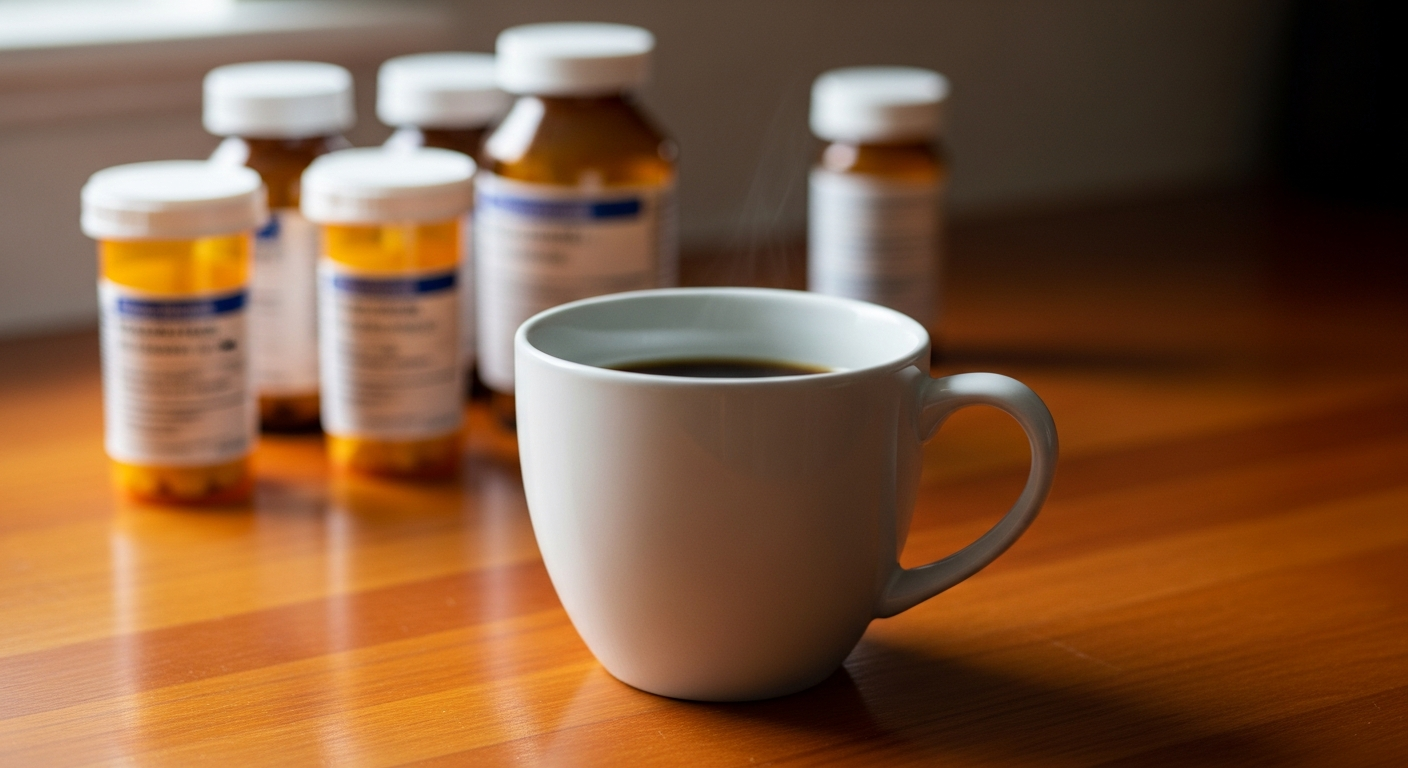
You take omeprazole (Prilosec), esomeprazole (Nexium), lansoprazole (Prevacid), or another proton pump inhibitor. Your doctor prescribed it because you have GERD, frequent heartburn, or another acid-related condition. The medication helps. But you also drink coffee, and you are wondering: Am I undoing what the medication is trying to do?
The answer is more nuanced than yes or no. Coffee does not cancel out your PPI, but it can work against it — and the specific compound responsible is one you can do something about.
Important disclaimer: This article is for educational purposes only. Do not change, reduce, or stop your PPI medication based on this article. PPIs are prescribed medications for serious conditions. Always work with your doctor on medication decisions. Nothing in this article constitutes medical advice.
How Proton Pump Inhibitors Work
To understand the coffee and PPI interaction, you need to understand what PPIs do at a cellular level.
Your stomach lining contains specialized cells called parietal cells. These cells produce hydrochloric acid through a mechanism called the proton pump — the hydrogen-potassium ATPase enzyme. This enzyme actively pumps hydrogen ions into the stomach, creating the acidic environment needed for digestion.
PPIs work by irreversibly binding to these proton pumps, shutting them down. Once a proton pump is deactivated by a PPI, it stays deactivated until your body produces a new one. PPIs do not neutralize acid like an antacid (Tums), and they do not reduce acid production temporarily like an H2 blocker (famotidine). They disable the acid-producing machinery itself.
However, PPIs have limitations:
They Do Not Shut Down All Proton Pumps
A single dose of omeprazole inhibits about 70 percent of active proton pumps. The remaining 30 percent continue producing acid. This is by design — you need some stomach acid for digestion, nutrient absorption, and protection against pathogens.
They Only Work on Active Pumps
PPIs can only bind to proton pumps that are active at the time the medication reaches peak blood levels. This is why doctors recommend taking PPIs 30 to 60 minutes before a meal — the meal stimulates pump activation, and the PPI is there to catch them as they turn on.
New Pumps Are Constantly Being Produced
Your body replaces proton pumps continuously. Roughly 25 percent of proton pumps are newly synthesized each day. These new pumps are fully functional until the next PPI dose can deactivate them.
There is always a baseline level of acid production happening, even on PPIs. The medication reduces total acid volume but does not eliminate it.
How Coffee Interacts With PPIs
This is where it gets complicated for coffee drinkers on PPIs.
CQA: The Compound Working Against Your Medication
Chlorogenic Acid (CQA) is the dominant acid in coffee. UC Davis researchers identified it as the primary cause of coffee-related heartburn. CQA stimulates parietal cells to produce more stomach acid.
When you take a PPI, you deactivate roughly 70 percent of your proton pumps. The remaining 30 percent continue working normally. Now you drink a cup of regular coffee with its full complement of CQA. That CQA stimulates the remaining active parietal cells and their functional proton pumps to increase acid output.
The result: the proton pumps your PPI did not reach are now being pushed to work harder, partially offsetting the acid reduction your medication achieved. You are pressing the brake and the gas pedal at the same time.
The Practical Impact
This does not mean your PPI stops working when you drink coffee. The 70 percent of proton pumps that the PPI deactivated stay deactivated regardless of how much CQA you consume — CQA stimulates acid production through active pumps, but it cannot reactivate pumps the PPI has already disabled.
What it does mean is that your effective acid reduction is less than it could be. Instead of the 70 percent reduction your PPI is designed to provide, you might functionally be getting 50 to 60 percent reduction during and after coffee consumption because the remaining active pumps are in overdrive.
For many PPI users, this gap is the reason they still experience breakthrough symptoms despite being on medication. They take their omeprazole faithfully, yet they still get heartburn after their morning coffee. The medication is working — just not enough to overcome the CQA-driven acid spike from regular coffee.
Caffeine Is a Secondary Factor
Caffeine also stimulates gastric acid secretion and can relax the lower esophageal sphincter (LES), potentially allowing acid to reflux upward. However, caffeine’s effect on acid production is modest compared to CQA’s effect. Many people still experience reflux from decaf coffee, which retains its CQA content while having minimal caffeine — evidence that CQA, not caffeine, is the dominant factor.
Timing Compounds the Problem
Many people take their PPI first thing in the morning and follow it with coffee. If the coffee comes too soon after the PPI — before the medication has reached peak blood levels — the CQA may stimulate acid production during the window when the PPI has not yet fully engaged. This timing mismatch can further reduce the effective acid suppression.
What Doctors Typically Recommend
If you ask your gastroenterologist about coffee and PPIs, you will likely hear some version of the following:
The Conservative Recommendation
“Avoid coffee entirely.” This is the safest advice from a medical liability standpoint and is technically the most effective way to eliminate coffee-related acid production. It is also the advice most patients find impossible to follow long-term.
The Moderate Recommendation
“Limit coffee to one cup per day and do not drink it on an empty stomach.” This is pragmatic and reflects the reality that most patients will not give up coffee. It reduces but does not eliminate the CQA exposure.
The Timing Recommendation
“Take your PPI at least 30 minutes before eating, and have your coffee with or after breakfast, not before.” This maximizes the window for the PPI to reach peak effectiveness before CQA enters the picture. It is good advice regardless of what coffee you drink.
What Most Doctors Miss
Most gastroenterologists do not distinguish between different types of coffee because, until recently, there was no meaningful distinction to make. Coffee was coffee — some was darker roasted, some was cold brewed, but the CQA reduction from these methods was modest and inconsistent.
Convection-roasted low-CQA coffee is newer and has not yet entered standard gastroenterological recommendations. But the logic is straightforward: if CQA stimulates acid production against your PPI, and convection roasting reduces CQA, then switching to convection-roasted coffee reduces the conflict between your coffee and your medication. You can read more about how convection roasting compares to drum roasting.
The Case for Low-CQA Coffee on PPIs
If you are on a PPI and you are going to drink coffee — which statistically, you probably are — the question becomes: What kind of coffee minimizes the conflict with your medication?
Reducing CQA Makes Your PPI Work Closer to Its Potential
With less CQA stimulating your remaining active proton pumps, the 30 percent of pumps your PPI did not deactivate are not being pushed into overdrive. They produce their normal baseline level of acid rather than a CQA-spiked elevated level. Your effective acid reduction stays closer to the 70 percent your medication is designed to deliver.
This is not a theoretical argument. People notice this. The most common feedback we hear from PPI users who switch to Low Acid Cafe is that their breakthrough symptoms improve. They do not stop their medication — they just stop fighting it with their coffee choice.
It Addresses the Right Problem
The distinction between pH-adjusted coffee and CQA-reduced coffee matters here. A coffee that has been treated with calcium carbonate to raise its pH does not help a PPI user. The CQA is still present, still stimulating acid production through active proton pumps. The alkaline additive may neutralize the coffee’s own acidity, but it does not prevent the coffee from triggering your stomach to produce more acid. For a thorough explanation, see our guide on what low-acid coffee means.
CQA-reduced coffee (achieved through convection roasting) reduces the compound working against your medication.
It May Support PPI Step-Down
A strong caveat: never reduce or stop a PPI without your doctor’s guidance. PPI discontinuation requires medical supervision because of rebound acid hypersecretion — a temporary increase in acid production that occurs when PPIs are stopped, which can make symptoms temporarily worse than they were before treatment.
That said, many doctors do want to help patients step down from long-term PPI use when appropriate. Long-term PPI use has been associated with potential risks including reduced magnesium absorption, reduced calcium absorption, increased risk of certain infections, and possible kidney effects. For patients who are stable and whose underlying condition is well-managed, reducing PPI dosage or frequency is often a goal.
Switching to low-CQA coffee before a PPI step-down is a sensible preparatory measure. If you reduce the acid production triggers in your diet before reducing the medication that suppresses acid production, the transition is more likely to be smooth. Your doctor can factor this into your step-down plan.
Some patients also find that combining low-CQA coffee with d-limonene supplementation provides enough reflux management to support PPI reduction. For more on this combination approach, see our article on d-limonene and coffee.
Practical Guidelines for Coffee on PPIs
Optimize Your PPI Timing
Take your PPI exactly as prescribed — typically 30 to 60 minutes before your first meal of the day. This ensures the medication reaches peak blood levels before you eat or drink anything that stimulates acid production.
Delay Your Coffee
Do not make coffee the first thing that hits your stomach. Have breakfast first, or at least eat something small. This gives your PPI more time to work and provides a food buffer that reduces the impact of any CQA that does reach your stomach.
Switch to Low-CQA Coffee
This is the most impactful change a coffee-drinking PPI user can make. Low Acid Cafe is convection-roasted to reduce CQA, lab-verified, organic, fair trade, and free of additives. It is a medium roast that tastes good — not the bitter, flat profile of dark roasts or the chalky taste of additive-treated coffees. Visit the science page for details on our process and verification.
Use Paper Filters
Brew your coffee with a paper filter (drip or pour-over method). Paper filters trap certain oils and compounds that contribute to stomach irritation. This is a small, easy change that complements your coffee selection.
Keep Volume Reasonable
One to two cups per day is a sensible maximum for PPI users. Even with low-CQA coffee, more volume means more total CQA exposure and more caffeine. There is a point of diminishing returns.
Track Breakthrough Symptoms
Keep a simple log of when you experience reflux symptoms relative to your PPI dose and coffee consumption. Patterns emerge that help you (and your doctor) optimize your routine. Maybe you do fine with morning coffee but afternoon coffee causes problems. Maybe two cups is one too many. Your body gives you the data if you pay attention.
Consider D-Limonene as a Complement
D-limonene — a natural compound from orange peel — provides an additional layer of protection by coating the esophageal lining. For PPI users who still experience breakthrough reflux despite switching to low-CQA coffee, adding d-limonene can fill the gap. Orange Burps is a d-limonene supplement designed for acid reflux support. Read our full article on combining d-limonene with low-acid coffee.
Frequently Asked Questions
Will coffee make my omeprazole stop working?
No. Coffee does not deactivate the proton pumps your PPI has already shut down. What it does is stimulate the remaining active pumps to produce more acid, reducing your net acid suppression. Your omeprazole is still working — coffee just partially counteracts the benefit on the margin. Switching to low-CQA coffee minimizes this effect.
Should I switch to decaf while on a PPI?
Decaf reduces caffeine intake, which modestly helps. But decaf still contains full CQA levels, which is the primary compound stimulating acid production. A regular-caffeine, low-CQA coffee may be a better choice for a PPI user than standard decaf. Ideally, a low-CQA decaf addresses both concerns. Check our FAQ for more questions.
Can I take my omeprazole with coffee?
PPIs should be taken with plain water, not coffee. The medication needs to be absorbed into the bloodstream and reach the parietal cells before those cells are stimulated by food or coffee. Taking it with coffee means the CQA starts stimulating acid production before the PPI can fully engage. Take your PPI with water, wait 30 to 60 minutes, eat something, then have your coffee.
Is it safe to take d-limonene alongside omeprazole?
There are no well-documented interactions between d-limonene and PPIs. However, always inform your doctor about any supplements you take alongside prescription medications. Your pharmacist is also a valuable resource for checking potential interactions.
How quickly will I notice a difference after switching to low-acid coffee?
Most PPI users notice reduced breakthrough symptoms within the first few days of switching. Since you are already on acid-suppressing medication, the reduction in CQA removes the extra stimulation that was causing the remaining active pumps to overperform. The effect is usually apparent quickly.
Can low-acid coffee replace my PPI entirely?
Do not stop your PPI based on coffee changes alone. PPIs are prescribed for serious conditions including GERD, Barrett’s esophagus, esophagitis, and Zollinger-Ellison syndrome. Switching to low-CQA coffee reduces one acid production trigger but does not replace the comprehensive acid suppression that PPIs provide. Any medication changes should be discussed with and supervised by your doctor.
Making Coffee and PPIs Work Together
Most people on PPIs continue to drink coffee. Your gastroenterologist probably knows you drink coffee even if they told you not to. The pragmatic question is how to do it in a way that works with your medication rather than against it.
Low-CQA coffee is the most evidence-aligned answer. It reduces the specific compound (CQA) that stimulates acid production through your remaining active proton pumps, allowing your medication to deliver closer to its designed effectiveness. It does not require giving up the coffee ritual, settling for bad-tasting alternatives, or adding more medications to your routine.
Low Acid Cafe exists for exactly this situation. Convection-roasted, lab-verified low CQA, organic, fair trade, medium roast, no additives. It is the coffee that does not fight your medication. Explore the science behind the process or order a bag and see how your next morning coffee feels different.