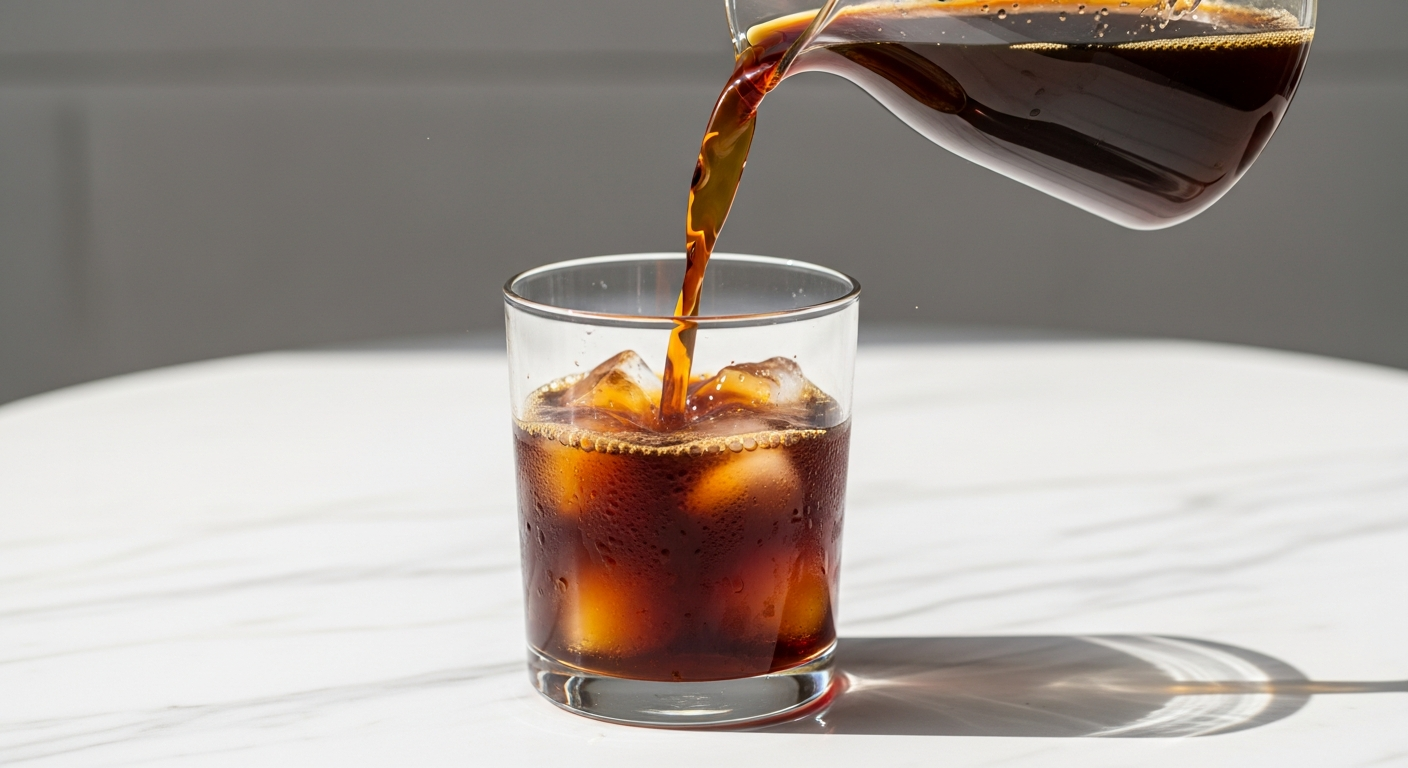
The Cold Brew Claim
Cold brew has earned a reputation as the stomach-friendly coffee option. Walk into any coffee shop and you will hear someone order it “because it’s easier on my stomach.” The claim is everywhere — on packaging, in health articles, across social media.
And it is partly true. Cold brew does extract fewer acidic compounds than hot brewing. But the full picture is more complicated, and if you stop at “cold brew = low acid,” you may be leaving the biggest acid-reduction tool on the table.
How Cold Brew Reduces Acidity
Temperature drives chemical extraction. When hot water (195–205°F) hits ground coffee, it pulls compounds out of the beans fast and hard. Chlorogenic Acid (CQA) — the primary compound responsible for stimulating excess stomach acid — dissolves with ease in hot water.
Cold water (room temperature or below) extracts the same compounds, but at a fraction of the rate. Over a 12- to 24-hour steep, cold brew pulls out an estimated 60–70% less CQA than a standard hot brew of the same beans.
That is a meaningful reduction. For someone whose stomach reacts to regular hot coffee, cold brew can make a noticeable difference.
The mechanism is straightforward: CQA has a temperature-dependent solubility curve. Higher temperatures increase the rate at which CQA molecules leave the bean matrix and enter the water. Lower temperatures slow that process. Even with the extended steep time, cold water never reaches the extraction efficiency of hot water for these particular compounds.
For more on why CQA matters, see our full explanation of Chlorogenic Acid.
The Part Most People Miss
Cold brew reduces how much CQA you extract from the beans. It does not change how much CQA is in the beans to begin with.
This distinction matters. A lot.
If you cold brew standard, drum-roasted coffee beans, you get less CQA than hot-brewing those same beans. But the beans still started with their full CQA load. You extracted less of it — maybe 30–40% of what hot water would have pulled — but 30–40% of a high number can still be enough to trigger symptoms.
Compare that to starting with beans that have already had their CQA reduced through the roasting process. Convection roasting — where circulating hot air replaces contact with a hot metal drum — breaks down CQA with more uniform and complete coverage at any given roast level. The beans themselves contain less CQA before water ever touches them.
This creates a situation that surprises most people: a hot cup of convection-roasted coffee can contain less CQA than a cold brew made from standard beans.
Brewing method and roasting method are two separate levers. Most people only know about the first one.
Two Levers, Not One
Think of CQA content in your cup as a product of two factors:
Factor 1: How much CQA is in the beans (determined by roasting)
Standard drum roasting leaves a baseline level of CQA. Dark roasting reduces it somewhat (more on that in our dark roast vs. light roast comparison). Convection roasting reduces it further, even at a medium roast level. The roasting method sets the ceiling.
Factor 2: How much of that CQA ends up in your cup (determined by brewing)
Hot water at 200°F extracts CQA with force. Cold water extracts far less. Grind size, brew time, and water-to-coffee ratio also play roles, but temperature is the dominant variable.
You can pull either lever on its own. You can also pull both.
A Rough Comparison
To put numbers in context, imagine the CQA in a standard hot-brewed cup as a baseline of 100%. These are approximate relative values, not lab measurements, but they illustrate the relationships:
| Method | Relative CQA Level |
|---|---|
| Regular beans, hot brewed | 100% (baseline) |
| Regular beans, cold brewed | 30–40% |
| Convection-roasted beans, hot brewed | 20–30% |
| Convection-roasted beans, cold brewed | 8–15% |
The gap between rows 2 and 3 is the key insight. Switching your beans does more than switching your brew method — even though cold brew gets all the attention.
And the bottom row shows what happens when you combine both approaches. That is the lowest CQA cup you can produce without giving up coffee altogether.
Our science page covers the lab verification behind convection roasting’s CQA reduction in more detail.
Why Cold Brew Became the Default Recommendation
Cold brew’s reputation comes from a few converging trends:
It is accessible. You do not need special beans. You do not need to research roasting methods. You put grounds in cold water, wait, and filter. Anyone can do it with any coffee they already own.
pH measurements look impressive. Cold brew tends to have a higher pH (less acidic on a pH scale) than hot coffee. This makes for clean marketing claims. The problem is that pH measures the acidity of the liquid itself, while CQA’s primary damage comes from triggering your stomach to produce its own acid. A higher-pH coffee that still delivers plenty of CQA to your stomach will still cause problems. We cover this distinction in our post on what low-acid coffee means.
It tastes smooth. Cold brew’s flavor profile — sweet, mellow, low bitterness — reinforces the perception that it is gentler. And it is gentler in terms of taste. Whether it is gentler enough for your stomach depends on your sensitivity and the beans you used.
What Cold Brew Does Well
None of this means cold brew is a bad option. It has real strengths:
Genuine CQA reduction. 60–70% less is significant. For people with mild sensitivity, cold brew from regular beans may be all they need.
Smooth flavor. The low-temperature extraction produces a concentrate that is sweet, clean, and forgiving. It is hard to make bad-tasting cold brew.
Versatility. Cold brew concentrate can be diluted with water, milk, or poured over ice. It keeps in the fridge for up to two weeks.
Simplicity. No special equipment beyond a jar, a filter, and patience.
What Cold Brew Gives Up
Aromatic complexity. Hot water releases volatile aromatic compounds that cold water cannot. A hot pour-over or drip coffee has a richer, more layered smell and taste than cold brew from the same beans. If you value the full sensory experience of coffee, cold brew delivers maybe half of it.
Flexibility. Cold brew is one preparation style. You cannot make espresso, French press, or pour-over with it. If you believe cold brew is your only stomach-safe option, you have locked yourself into a single brewing method.
Speed. A 12- to 24-hour steep time means planning ahead. Run out on Tuesday morning and you are drinking something else until Wednesday.
Heat. Some people want hot coffee, in winter above all. You can heat cold brew concentrate, but that defeats part of the purpose — reheating reactivates some extraction of residual compounds, and the flavor profile changes.
The Best-Case Scenario: Convection Beans + Cold Brew
If you want the absolute gentlest cup of coffee, combine both levers:
- Start with convection-roasted, low-CQA beans (like ours)
- Cold brew them
You get beans with reduced CQA at the source, plus a brewing method that extracts even less of what remains. The result sits at the bottom of the comparison table above.
For people with GERD, IBS, or significant stomach sensitivity, this combination provides the widest safety margin. Our GERD coffee guide covers the full strategy for managing reflux through coffee choices.
How to Cold Brew at Home
If you want to try cold brewing with low-acid beans, the process is straightforward:
Ratio: 1 cup coarsely ground coffee to 4 cups cold or room-temperature water. Adjust to taste.
Grind: Coarse — about the texture of raw sugar. Too fine and you will over-extract even in cold water, plus filtering becomes difficult.
Steep time: 12–18 hours at room temperature, or 18–24 hours in the fridge. Longer steep times extract more, so if you are optimizing for the lowest possible CQA, stay closer to 12 hours at room temperature.
Filter: Pour through a paper filter or fine-mesh strainer lined with cheesecloth. Paper filters catch more oils and fine particles.
Storage: Refrigerate the concentrate. It keeps for 10–14 days. Dilute with water or milk at a 1:1 or 1:2 ratio before drinking.
Tip: If you want it warm, heat the diluted coffee (not the concentrate) to no more than 150°F. This warms it without the aggressive extraction of standard brewing temperatures.
Quick Answers
Is cold brew less acidic than hot coffee? Yes. Cold water extracts 60–70% less CQA than hot water from the same beans. The brewed liquid also has a higher pH.
Will cold brew fix my acid reflux? It helps, but it depends on how sensitive you are and which beans you use. Cold brew from standard beans still contains meaningful CQA. Cold brew from convection-roasted beans contains the least CQA of any brewing method.
Is cold brew better for IBS? Cold brew reduces CQA, which is one trigger for GI distress. But coffee also affects gut motility through other compounds, including caffeine. Cold brew addresses one pathway, not all of them. See our coffee and IBS guide for the full picture.
Does iced coffee have the same benefit as cold brew? No. Iced coffee is hot-brewed coffee poured over ice. It extracts the same amount of CQA as any hot brew — you are cooling it after the damage is done. Cold brew is brewed cold from the start.
Can I heat up cold brew? You can warm it, but keep the temperature moderate (under 150°F). Bringing it to a full boil would restart some of the extraction process with any residual grounds — though if you have filtered well, this is minimal.
The Bottom Line
Cold brew deserves its reputation as a gentler option. The CQA reduction is real and meaningful.
But if stomach comfort is your primary goal, the beans matter more than the water temperature. Convection-roasted coffee brewed hot contains less CQA than standard coffee brewed cold. That is the comparison most cold brew advocates do not make.
The best approach uses both tools. Start with beans roasted to reduce CQA. Brew them however you prefer — hot, cold, or anywhere in between. And if you want the absolute minimum CQA in your cup, cold brew those low-acid beans.
You do not have to choose between your stomach and your coffee. You do not have to lock yourself into one brewing method. You need the right beans, and after that, every brewing option is on the table.
Explore our convection-roasted, lab-verified coffee or read the science behind CQA reduction.