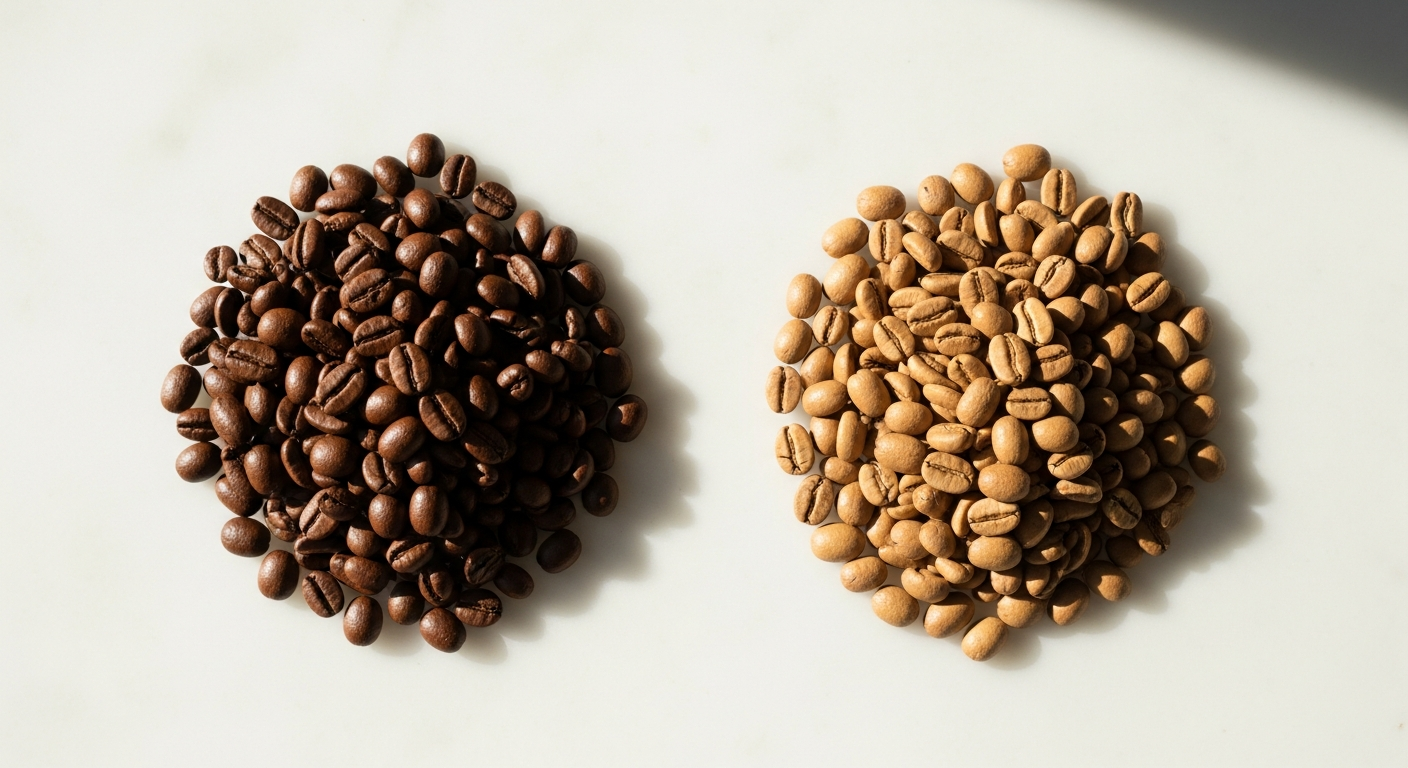
Roast Level and Stomach Comfort
“Go dark roast — it’s easier on your stomach.” You have heard this advice, and it is not wrong. Dark roasts do contain less Chlorogenic Acid (CQA) than light roasts. CQA is the compound most responsible for triggering excess stomach acid production, and longer roasting breaks more of it down.
But roast level involves a tradeoff that most stomach-comfort advice ignores: what happens to the flavor when you push a roast that far.
CQA and the Roasting Curve
Green (unroasted) coffee beans contain CQA at their highest concentration — about 6–8% of the bean’s dry weight, depending on the variety and growing conditions. CQA is part of the plant’s defense system, and Robusta beans carry more of it than Arabica.
When heat is applied during roasting, CQA begins to break down through a process called thermal degradation. The longer and hotter the roast, the more CQA is destroyed.
In broad terms:
| Roast Level | Internal Bean Temp | Approximate CQA Reduction |
|---|---|---|
| Light | 356–401°F | 10–20% |
| Medium | 410–428°F | 30–50% |
| Dark | 437–464°F | 50–70% |
Light roasts preserve most of the bean’s original CQA. They are roasted to first crack — the point where moisture inside the bean creates enough steam pressure to crack the cell structure. First crack happens around 385–400°F. The beans are pulled shortly after.
Medium roasts continue past first crack, spending more time at temperatures that degrade CQA. The reduction is meaningful but moderate.
Dark roasts push to second crack (around 435–450°F) or beyond. At these temperatures, CQA breaks down in large amounts. A French roast or Italian roast may retain only 30–50% of the original CQA content.
For a full explanation of CQA and why it matters, see our Chlorogenic Acid guide.
The Flavor Cost of Going Dark
CQA is not the only compound affected by extended roasting. High temperatures destroy volatile organic compounds — the molecules responsible for coffee’s aroma, sweetness, fruitiness, and origin character.
A light-roasted Ethiopian Yirgacheffe tastes different from a light-roasted Sumatran Mandheling. The beans carry distinct flavor signatures from their terroir, variety, and processing. Light roasting preserves these differences.
Push both beans to a dark roast, and they taste more similar than different. The dominant flavors become char, smoke, and a generic “roasty” bitterness. Origin character gets incinerated.
This is why specialty coffee roasters — the people who pay premium prices for exceptional green beans — almost never dark roast. It erases the qualities they paid for.
For stomach-sensitive coffee drinkers, this creates a bind. Dark roast reduces CQA but produces a cup that many people find flat, bitter, and one-dimensional. You trade stomach comfort for a coffee you tolerate rather than enjoy.
N-Methylpyridinium: The Dark Roast Bonus
Dark roasting does produce one compound worth noting: N-methylpyridinium, or NMP.
NMP forms during the Maillard reaction — the same browning chemistry that creates flavors in toasted bread, seared meat, and caramelized sugar. As roasting progresses, trigonelline (a naturally occurring compound in coffee beans) converts to NMP.
Research published in Molecular Nutrition & Food Research found that NMP may suppress hydrochloric acid secretion in stomach cells. This is the opposite of what CQA does. While CQA stimulates acid production, NMP may help tamp it down.
Dark roasts produce the most NMP. Light roasts produce the least. This gives dark roast a double advantage on paper: less CQA (the acid trigger) and more NMP (a potential acid suppressor).
But NMP production comes with the same tradeoff as CQA reduction — it requires the extended heat exposure that destroys flavor compounds. You cannot get high NMP without going dark, and going dark means accepting the flavor consequences.
NMP research is also still in early stages. Most studies have been conducted in cell cultures, not in large-scale human trials. The effect is promising but not yet proven at the level of clinical certainty that physicians would rely on for treatment recommendations.
The Roasting Method Variable
Most discussions about roast level and acidity assume conventional drum roasting — the standard method used by the vast majority of roasters worldwide.
In drum roasting, beans tumble inside a heated metal cylinder. The drum’s surface can reach temperatures well above the target bean temperature, creating hot spots where beans make direct contact with metal. This uneven heat application means some beans (or parts of beans) are over-roasted while others are under-roasted, even within the same batch.
This inconsistency matters for CQA reduction. The “average” CQA level in a drum-roasted batch masks a wide range of individual bean-level variation. Some beans had their CQA well-reduced. Others did not.
Convection roasting uses a different approach: heated air circulates around the beans, roasting them from all sides without direct contact with a hot surface. The heat distribution is more uniform, which means CQA breakdown is more consistent across the batch.
The practical result is that convection roasting achieves greater CQA reduction at any given roast level compared to drum roasting. A medium convection roast can match or exceed the CQA reduction of a dark drum roast — without pushing the beans to the point where flavor compounds are destroyed.
Our convection vs. drum roasting comparison covers the mechanical and chemical differences in detail.
Medium Roast: The Middle Path
Medium roast occupies an interesting position in this discussion.
At a medium roast level, enough thermal transformation has occurred to reduce CQA by 30–50% (in drum roasting) or more (in convection roasting). The beans have passed first crack and spent time at temperatures that degrade CQA, but have not reached the extreme temperatures that flatten flavor.
A medium-roasted coffee retains sweetness, body, and enough origin character to be interesting. It has some of the caramelization and Maillard reaction products that give coffee warmth and depth. It has not been pushed to char.
Medium roast also produces moderate NMP — less than dark, more than light. It sits in the middle of every relevant spectrum.
For someone using convection roasting, medium roast becomes the sweet spot. The roasting method compensates for the lower temperature by providing more uniform heat, achieving CQA reduction comparable to a dark drum roast while keeping the flavor profile of a medium.
This is the approach we use at Low Acid Cafe. Our Sumatran and Chiapas blend is convection roasted to a medium profile, targeting CQA reduction without sacrificing the qualities that make coffee worth drinking. Lab verification confirms the results.
What About Light Roast?
Light roasts retain the most CQA and the most flavor complexity. For stomach-sensitive drinkers, they represent the highest-risk option.
If you love light roast and have no stomach issues, there is no reason to change. Light roasts contain beneficial antioxidants (including CQA itself, which has antioxidant properties outside of its stomach acid effects). For healthy stomachs, CQA is not a problem.
But if light roast gives you heartburn, bloating, or reflux, the CQA content is the most likely explanation. Switching to a medium or dark roast — or to a convection-roasted medium — will reduce your CQA exposure.
Comparing Your Options
Here is how the combinations stack up for stomach comfort, ranked from most CQA to least:
- Light roast, drum roasted — Maximum CQA. Full origin flavor. Hardest on the stomach.
- Medium roast, drum roasted — Moderate CQA reduction. Good flavor. A step in the right direction.
- Dark roast, drum roasted — Significant CQA reduction. High NMP. Flavor tradeoff.
- Medium roast, convection roasted — Significant CQA reduction comparable to dark drum roast. Flavor preserved. Our pick.
- Dark roast, convection roasted — Maximum CQA reduction. Maximum NMP. Flavor is still more interesting than dark drum roast, but you lose some nuance.
Most people wanting both stomach comfort and a good cup will find their answer in options 3 or 4. The choice between them is whether you prefer the dark roast flavor profile or the medium roast flavor profile — the stomach impact is similar.
Practical Recommendations
If you drink light roast and your stomach hurts: Switch to medium roast first. Many people find this is enough. If you still have symptoms, try a convection-roasted medium like Low Acid Cafe.
If you drink dark roast for your stomach but miss good flavor: A convection-roasted medium roast gives you comparable CQA reduction with a more complex, balanced cup. You do not have to sacrifice taste for comfort.
If you want the absolute lowest CQA: Combine a convection-roasted coffee with cold brewing. Cold water extracts 60–70% less CQA, and when the beans already have reduced CQA, the result is the gentlest cup possible. See our cold brew acidity guide for details.
If you have GERD or significant reflux: Roast level alone may not be enough. Read our comprehensive GERD coffee guide for a full strategy that includes bean selection, brewing method, timing, and other factors.
The Myth of “Acidity” as a Single Thing
Part of the confusion around roast levels and acidity comes from the word “acidity” doing double duty.
In coffee tasting, acidity is a positive attribute. It refers to brightness, liveliness, and the pleasant tartness that makes coffee interesting. A light-roasted Kenyan coffee with high acidity is prized by specialty coffee professionals.
In stomach health, acidity refers to the production of hydrochloric acid in the stomach, triggered in large part by CQA. This is the acidity that causes heartburn, reflux, and GI discomfort.
These are different things. A coffee can taste “acidic” (bright, lively) without being high in CQA, and a coffee can be low in perceived acidity (smooth, flat) while still containing plenty of CQA.
When someone says “dark roast is less acidic,” they are correct on both counts — dark roast has less perceived acidity (brightness) in the cup and less CQA to trigger stomach acid. But these two types of acidity do not always move together, and understanding the difference helps you make better choices.
Your Roast, Your Call
Dark roast reduces CQA. That part of the advice is solid. If you enjoy dark roast and it works for your stomach, keep drinking it.
But if you have been forcing yourself to drink dark roast because you think it is your only stomach-friendly option, you have more choices than you realized. The roasting method — not only the roast level — determines how much CQA survives. Convection roasting at a medium level gives you CQA reduction and flavor in the same cup.
The right coffee for your stomach does not have to be a compromise. It can be a coffee you look forward to.
See the lab-verified results behind our roasting process or try a bag for yourself.